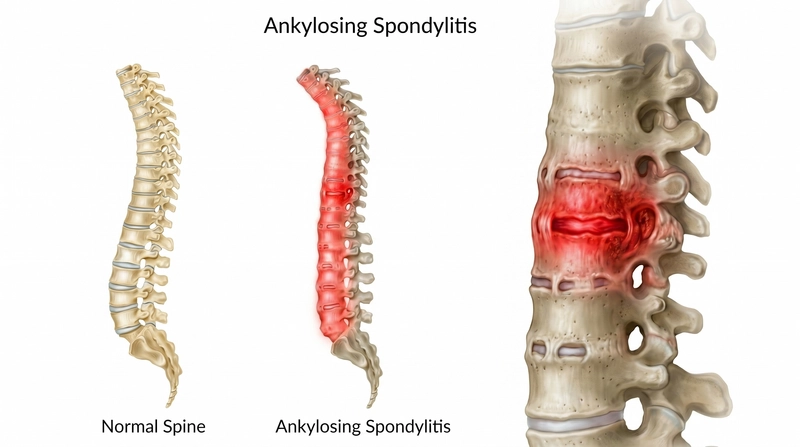
Ankylosing Spondylitis
Ankylosing Spondylitis is a chronic progressive inflammatory disease of the spine causing pain, stiffness, reduced mobility, and fusion in the spine.

Symptoms
Ankylosing Spondylitis initially presents with early morning stiffness and pain in the back, neck, and hips. It typically begins in early adulthood (ages 17–40) and can lead to severe restriction of movement if not managed properly. You may experience:
- Mild to severe pain in the lower back, buttocks, neck, and upper or mid back.
- Difficulty or increasing pain with movement.
- Worsening pain when resting, sitting, walking or standing.
- Stiffness or increasing pain in the morning which reduces with movement.
- Pain radiating from the buttocks or legs (one or both sides).
- Pain from the neck and upper back to the hands or fingers.
- Tingling, numbness, burning, imbalance or weakness in the legs, feet, hands and fingers (if disc is involved).
- Trouble urinating or passing motion.
Causes
The exact cause is not fully known, but some common contributing factors include:
- Genetics (HLA-B27, Anti CCP, ANA, CRP).
- Urethritis.
- Ulcerative colitis.
- Conjunctivitis.
- Klebsiella infection.
Diagnosis
History and physical examinations are usually sufficient, but confirmatory tests are used to rule out loss of lordosis, bridging osteophytes, and bamboo spine. Tests include:
- X-ray
- MRI
- CT scan
- DEXA scan
- HLA-B27
- Sr. IgA
Treatment
General measures that are extremely important in Ankylosing Spondylitis include:
- Patient education.
- Family education.
- Genetic counselling.
- Occupational therapy.
In early Ankylosing Spondylitis with no fusion at the lumbar or cervical spine and with an associated slip disc, the patient may be eligible for Non-Surgical Spinal Decompression. It is also important to guide the patient about the progression of the condition.
In cases of fusion, surgery is the best option as conservative or non-surgical approaches will have minimal to no effect.